
When a Cat Stops Using the Litter Tray, It Is Never Random
Posted by Dr. Amaya Espíndola, MRCVS on 16th Jan 2026
Dr. Amaya Espíndola, MRCVS is a holistic, cat and nutrition specialist, veterinarian based in Mallorca and the current president of the Raw Feeding Veterinary Society. She offers online consultations worldwide, focusing on nutrition as the first line of therapy. With a background in psychosomatic medicine, Amaya approaches each case by considering the deep connection between physical symptoms and emotional wellbeing, aiming to support feline health from a truly integrative perspective. You can find her at felvet.co.uk and on Instagram at @felvetforcats.
When a cat starts defecating outside the litter tray, it is easy to assume bad behaviour, defiance, or even revenge. None of these explanations reflect how cats experience the world. Cats do not act out of spite, and they do not soil the house on purpose.
When a cat stops using the litter tray, there is always a reason. Finding that reason requires looking beyond a single cause and considering several layers at the same time: the body, the environment, and the emotional and social context in which the cat lives.
Understanding this changes the way the problem is approached. Instead of reacting with urgency or frustration, it becomes a process of observation, interpretation, and adjustment.
A Quick Overview For Those Who Want The Essentials
If your cat is not using the litter tray for defecating, these are the key points to keep in mind:It is not random, and it is not intentional
- It is not always diarrhoea or constipation
- Physical discomfort is often involved, even when stools look normal
- The litter tray itself and its location matter more than most people realise
- Emotional and social factors can influence elimination behaviour
- Observation is often more useful than rushing to fix the problem
For those who want to understand why this happens and what to look at more carefully, the following sections explore each layer in detail.
What “Defecating Outside The Litter Tray” Really Means
This situation does not only refer to loose stools or obvious digestive upset. Many cats pass formed stools but choose not to use the litter tray. The behaviour can occur close to the tray, in beds, on carpets, on sofas, or in seemingly random places.
What defines the issue is not the appearance of the faeces, but the fact that the litter tray is being avoided. This distinction is important because focusing only on stool consistency can lead to missing the underlying cause.
Reasons Why Your Cat Won't use Litter Tray
1. Looking at the Body: Physical Causes to Consider
Physical discomfort is one of the most common contributors to litter tray avoidance. Importantly, this discomfort is not always obvious.
Constipation can be present even when stools are not particularly hard. A previous painful experience can be enough for a cat to associate the act of defecation with discomfort, leading to avoidance of the tray later on.
Diarrhoea, intestinal inflammation, and parasites can also change how a cat experiences urgency and control, making the litter tray feel unsafe or unpleasant.
Joint pain and arthritis are frequently overlooked. The posture required to enter a tray, turn around, and squat can be uncomfortable, especially for older cats, overweight cats, or cats with reduced mobility. In these cases, the issue is not the tray itself, but the physical effort required to use it.
Chronic conditions such as kidney disease or systemic inflammation can create a general sense of malaise. Even when the digestive tract is not directly affected, a cat that feels unwell may express that discomfort through changes in elimination behaviour.
2. Looking at the Environment: The Litter Tray and the Space Around It
The litter tray is not a neutral object. For a cat, it is a functional space that must feel accessible, predictable, and safe.
Location matters. A tray placed in a narrow corridor, a busy area, or a space where the cat feels observed or cornered can become unusable, even if it appears practical to humans. If reaching the tray means crossing another cat’s territory or passing through an area without escape options, avoidance is likely.
The tray itself also plays a role. Size, depth, type of litter, and cleanliness all influence whether a cat feels comfortable using it. Some cats tolerate changes easily, while others are highly sensitive to texture, smell, or sudden modifications.
In multi cat households, the social meaning of the tray becomes even more important. A litter tray can turn into a contested resource, even without visible aggression. Subtle tension is enough to make elimination feel risky.
3. Looking at Emotional and Social Factors
Emotional factors are often reduced to the word stress, but this oversimplifies what is really happening.
Cats are deeply affected by how secure they feel in their social and spatial environment. Changes in routine, new animals, alterations in the household, or unresolved tension between cats can all influence elimination behaviour.
The key issue is not simply whether something stressful occurred, but whether the cat feels able to navigate its environment without uncertainty. Lack of control, unpredictability, and social pressure can all push a cat to choose a different place to eliminate.
While urine marking is more commonly associated with social conflict involving people, defecation outside the tray can still occur when the overall level of discomfort is high enough.
4. Diet as a Contributing Factor
Diet plays a significant role in cats not using the litter tray, not only in stool quality, but in how the cat experiences its own body.
Some diets contribute to constipation, heaviness, or intestinal inflammation without producing dramatic symptoms. Others affect weight, which in turn influences mobility and comfort when using the tray.
Excess weight can make squatting, turning, and maintaining posture more difficult. In these cases, the issue is not behavioural but functional.
Looking at what the cat eats, how it digests it, and how it moves as a result is an essential part of understanding elimination problems.
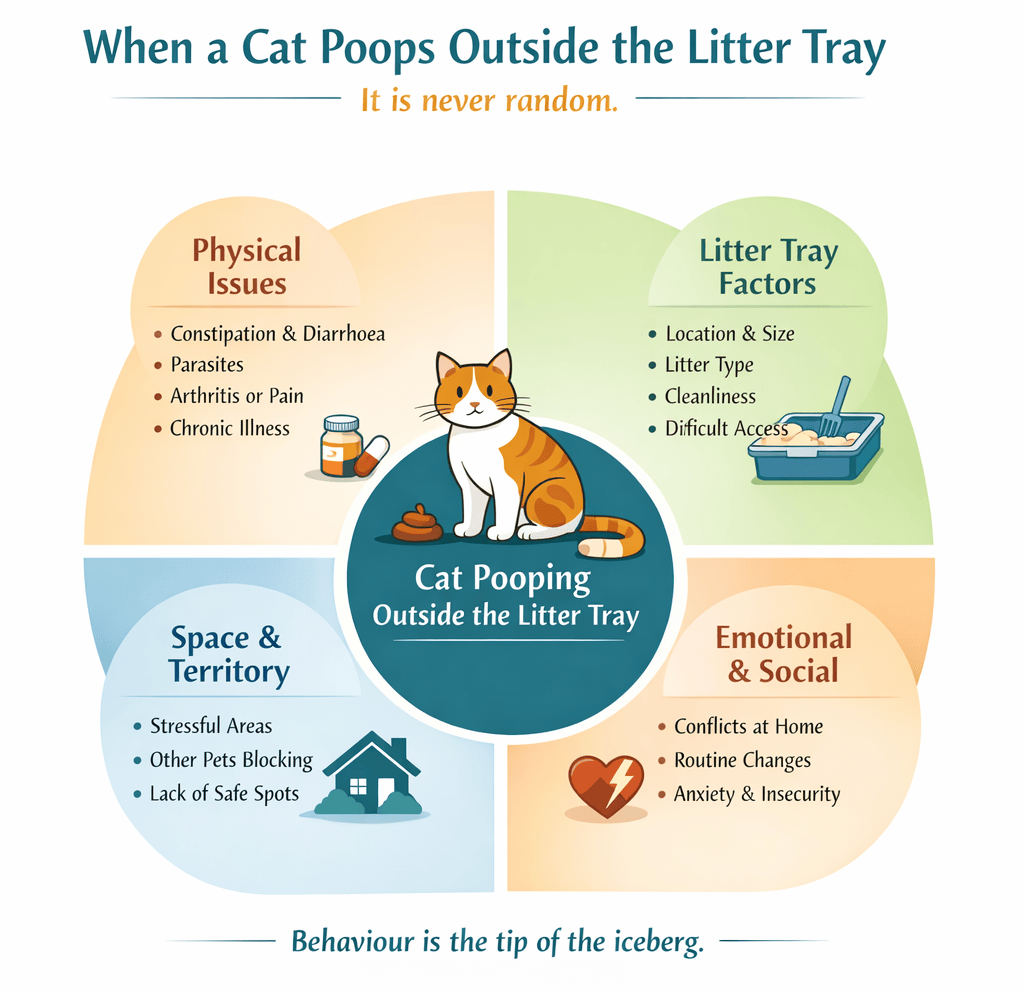
To Recap:
What to do When it Happens
In most cases, panic is not helpful. Unless there is acute diarrhoea, obvious pain, or a sudden decline in health, the first step is observation.
Keeping track of when and where the behaviour occurs, changes in routine, diet, household dynamics, and the cat’s general wellbeing provides valuable information.
This process helps build a clearer picture and makes any professional support far more effective. If no solution is found, it is reasonable to seek a broader perspective rather than assuming the problem is unsolvable.
A Final Thought
When a cat stops using the litter tray, it is not challenging authority or breaking rules. It is responding to how its body feels and how it experiences its world.
Approaching the situation with curiosity instead of judgement allows the real message behind the behaviour to emerge, and that understanding is often the first step towards resolution.
Dr. Amaya Espíndola, MRCVS
References
- Dehasse, J. (2018). The Psychology of the Cat. CABI Publishing.
- Dehasse, J. (2019). The Education of the Cat. CABI Publishing.
- Marchesini, R. (2021).The Science of the Cat: What We Know About Our Feline Companions. Giunti Editore.
- Case, L. P., Daristotle, L., Hayek, M. G., & Raasch, M. F. (2011).Canine and Feline Nutrition: A Resource for Companion Animal Professionals (3rd ed.). Elsevier Mosby.