
Best Low-Calorie Cat Food: How to Compare It Properly
5th Nov 2026
If your cat has noticeably gained weight, or your vet has recommended weight loss, you might be looking for a lower-calorie food. With so many products labelled “light”, “slim” or “diet”, it can be difficult to know which is actually the best choice.
A UK veterinary study found that 11.6% of 18,249 cats in its sample were recorded as obese, highlighting how common weight problems can be. The first step is to speak to your vet about your cat’s ideal weight and daily calorie allowance. From there, you can compare foods using the information on their labels rather than relying on marketing claims alone.
What does low-calorie cat food actually mean?
Low-calorie cat food provides less energy for a given amount of food. Energy is measured in kilocalories (kcal), usually displayed on product labels as kcal per 100g, per pouch, or per serving. However, a food being lower in calories does not automatically make it the right choice for your cat.
Daily calorie needs depend on factors including ideal body weight, age, activity levels, neutering status and health. Even a relatively low-calorie food can provide too much energy if you feed large portions. Equally, reducing portions too far could leave your cat without essential nutrients. The aim is to find a complete, balanced food that meets your cat’s nutritional needs while allowing you to follow the feeding plan recommended by your vet.
What is the best low-calorie cat food?
The best low-calorie cat food is one that fits your cat’s individual calorie allowance, supplies their essential nutrients and can be fed consistently in appropriate portions. There is no single recipe that suits every cat. Some may benefit from a veterinary weight-management diet, while others may be able to follow a carefully portioned plan using a suitable complete food they already enjoy.
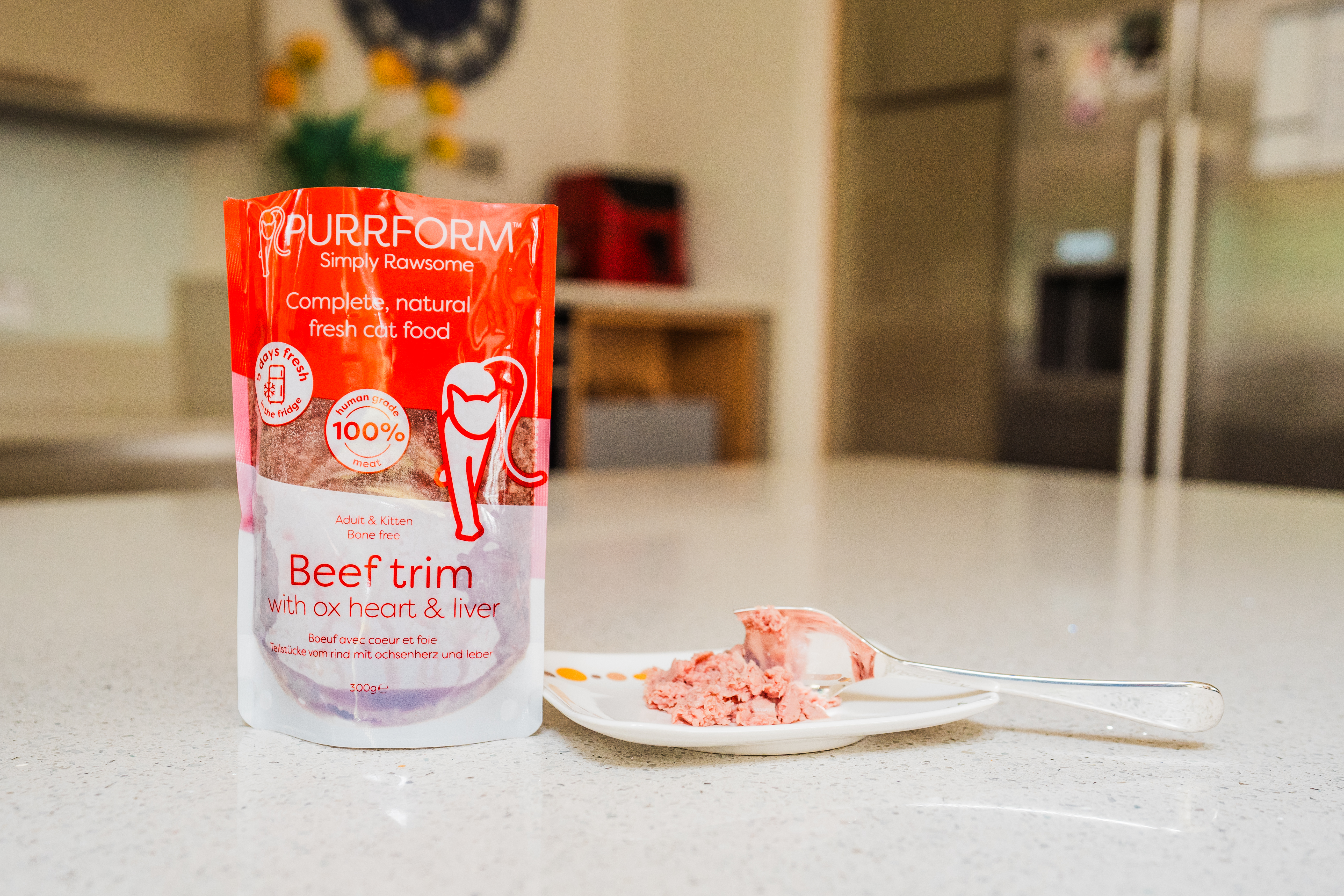
If you are considering raw or fresh food, checking the calorie information can help you understand how different recipes compare. Purrform’s complete recipes, for example, have different published energy values, even within the same range.
|
Purrform complete recipe |
Range and pack |
Calories per 100g (kcal) |
|
5 Days Fresh, 300g |
108 |
|
|
Fresh Deli, 7 x 70g |
114 |
|
|
7 x 70g |
121 |
|
|
- |
125 |
|
|
- |
137 |
|
|
Chicken with ground bone, chicken liver, heart and gizzard (adult) |
- |
155 |
|
Turkey and ground bone with turkey heart and liver (adult) |
- |
159 |
These examples show why it is worth comparing individual recipes. The foods listed above range from 108 to 159 kcal per 100g, meaning two recipes from the same brand can provide quite different amounts of energy. A lower figure does not necessarily mean a food is more suitable for your cat. Your vet can help you decide which recipe and portion size fit your cat's nutritional needs and weight-management plan.
What does “light” mean on a cat food label?
Packaging terminology can make choosing food confusing. Under FEDIAF’s Code of Good Labelling Practice for Pet Food, a “light” claim referring to energy content should indicate an energy density at least 15% lower than that of a comparable standard adult maintenance food.
Other terms, such as “slim”, “diet” and “low-calorie”, do not carry the same specific threshold under this guidance. They are not enough on their own to tell you how much energy a product provides.
Rather than relying on a recipe’s name, look for its calorie information and compare it with your cat’s current food. If the figure is not available on the packaging or product page, ask the manufacturer.
How do you work out how many calories your cat needs?
Once you have found a food with a suitable calorie content, the next step is working out how much to feed. Your vet should set a daily calorie target based on your cat’s ideal weight, current condition and individual needs. Do not use the feeding guide on a packet as a weight-loss plan without checking whether it is appropriate for your cat. You can then use the calorie information to understand how much of a particular food fits that allowance.
For example, a food providing 108 kcal per 100g supplies 54 kcal in a 50g portion. Another food providing 160 kcal per 100g supplies 80 kcal in the same portion. Our Rawsome Catculator can help you estimate feeding amounts. For a cat that needs to lose weight, follow your vet’s recommended allowance rather than relying on a general calculator alone.
How does raw or fresh cat food compare?
Raw and fresh foods also vary in calorie content. Moisture levels, ingredients and the proportions of different cuts of meat all affect the final figure. You should not assume that all raw food is low in calories, or that fresh food will automatically help your cat lose weight. Check the individual recipe rather than making a decision based on the type of food alone.
For a fair comparison, look at:
- Calories per 100g: a useful starting point for comparing products.
- Calories per pouch or serving: helpful when feeding pre-portioned food.
- Daily calorie intake: the total energy your cat receives from meals, treats and extras.
- Nutritional completeness: whether the food is labelled complete and suitable for your cat’s life stage.
The most useful comparison is how much energy your cat receives throughout the day, not simply which food has the lowest number on the packet. Foods contain different amounts of moisture, so equal weights may provide very different amounts of energy. Comparing kcal per 100g is useful, but you also need to consider portion size and total daily calorie intake.
How to change your cat’s food safely
If you decide to introduce a different cat recipe, avoid making a sudden switch unless your vet advises otherwise. A gradual transition gives your cat time to adjust and allows you to monitor how they respond. The process will depend on the type of food, your cat’s preferences, and any dietary advice from your vet. Our guide to transitioning to raw food explains the process in more detail.
If you are unsure which recipe your cat will enjoy, a trial pack can be a practical way to explore suitable options before committing to a larger order. Check the calorie content and complete-food status of each recipe before choosing one for a weight-management plan.
Choosing the right food for your cat
Finding the best low-calorie cat food starts with understanding the numbers. Compare calorie density, work out how portions contribute to daily intake, and check that the food is complete and balanced. Purrform offers a range of raw and fresh recipes with published calorie information, giving you a starting point for comparing different options. The right choice depends on your cat’s needs, preferences, and the plan agreed with your vet.
If your cat needs to lose weight, start with a conversation with your vet, then use the information on individual product pages to make a more informed decision about their food.
Best low-calorie cat food FAQs
What cat food has the fewest calories?
There is no single type of cat food that always has the fewest calories. Calorie content varies between products and recipes, so compare kcal per 100g and the calories in the portion your cat will eat. The food must still meet their nutritional needs, and your vet should guide any weight-loss plan.
Is low-calorie wet cat food better than dry food?
Not necessarily. Wet food generally contains more moisture and fewer calories per 100g than dry food, but the total calories depend on the product and portion size. Compare daily energy intake rather than choosing based on food type alone.
Can raw cat food help with weight loss?
Raw food is not automatically a weight-loss solution. Recipes vary in calorie content, and the amount fed still matters. A suitable complete food can be considered as part of a vet-guided plan, but switching food alone does not guarantee weight loss. Read our guide to raw diets and weight loss for more information.
Is “light” cat food always lower in calories?
Under FEDIAF’s labelling guidance, a food labelled “light” must have an energy density at least 15% lower than a comparable standard adult maintenance food. Other terms, including “slim” and “diet”, do not carry the same specific threshold under that guidance. Always check the product’s calorie information.
How much food should I give my overweight cat?
Ask your vet to calculate an appropriate daily calorie allowance based on your cat’s ideal weight and health. You can then use the food’s calorie information to calculate portions, including treats and extras. Avoid making drastic reductions to their normal food without veterinary guidance.
How can you compare low-calorie cat food fairly?
When comparing foods, look beyond the calorie figure and consider how much your cat will actually eat. Wet, dry, raw, and fresh foods contain different amounts of moisture, affecting how many calories they provide per 100g.