The Treatment & Diagnosis Of Cancer In Cats
Posted by Dr Vicki Adams on 22nd Apr 2026
This month’s article is presented by Vicki Adams, Veterinary Epidemiology Consultant & Chief Executive of The Animal Cancer Trust and focuses on cancer in general, in cats. It discusses how they can be diagnosed and where possible, treated.
The most common cancers of cats include lymphoma, squamous cell carcinoma, mammary carcinoma and soft tissue sarcoma (Table 1). When lumps and enlarged lymph nodes (glands) are found in a cat, there are more non-cancerous disease possibilities (differential diagnoses) than for dogs. Cats can develop markedly enlarged lymph nodes as a result of infection or reactive inflammation.
Clinical Presentation
As cats are both a predator and a prey species, they tend to hide the fact that they are not feeling well, making a diagnosis more difficult in the early stages. Affected cats may present with a lump or a mass lesion or nonspecific signs that may include lack of appetite, reduced activity and weight loss. Cases present in many different ways depending on the body organ(s) affected. Clinical signs may include vomiting, diarrhoea, a palpable mass in the abdomen or breathing difficulties. Unfortunately, many cats hide disease well and will only present with advanced disease and not always as a result of the primary tumour.
Diagnosis Of Cancer In Cats
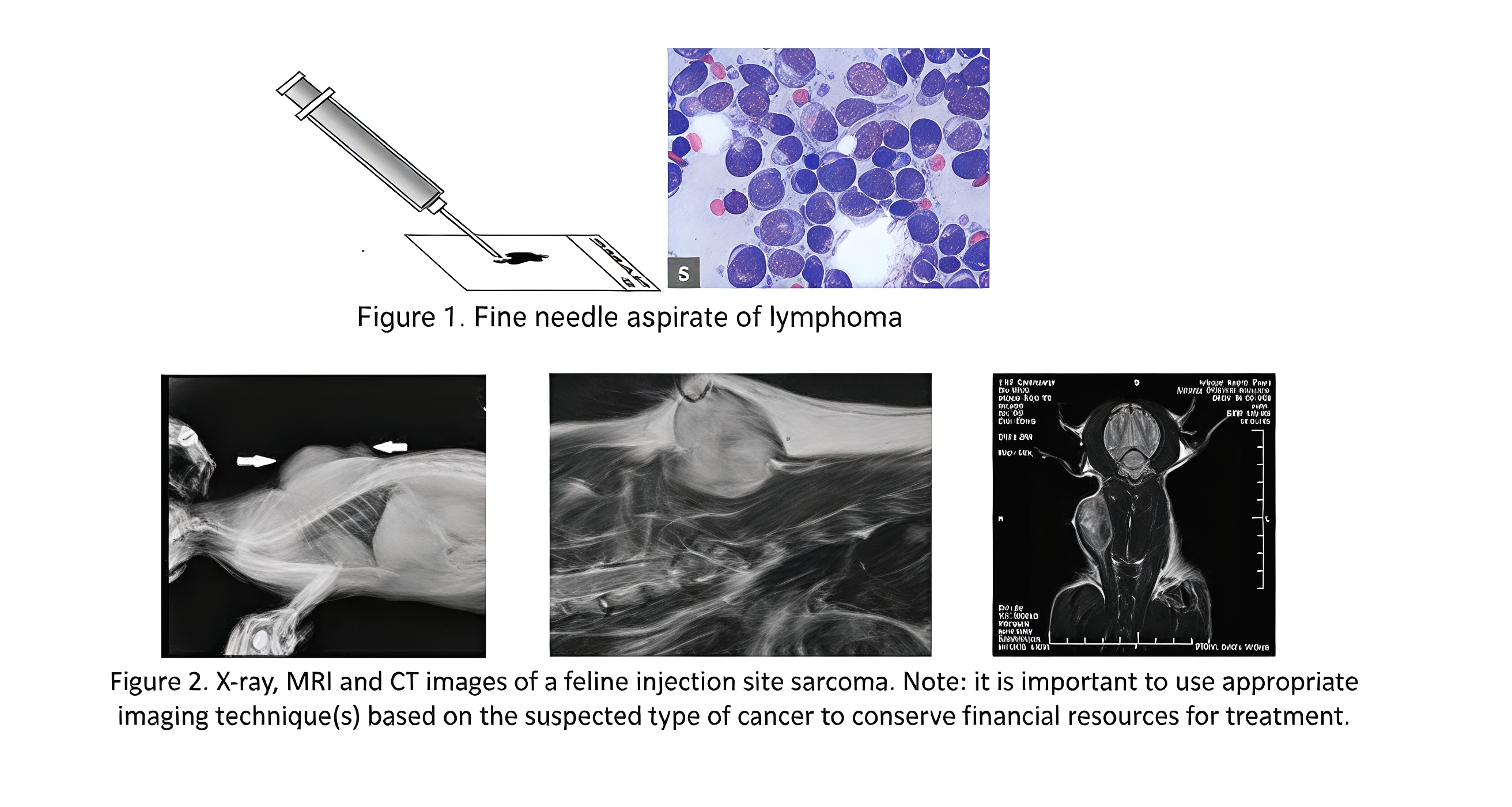
A thorough physical examination of the cat is always an essential part of the diagnostic process (work-up) as it will determine which further tests will be required. Complete blood cell counts and biochemistry tests can help to reveal which organs are involved and whether there is any concurrent disease. A diagnosis of cancer is usually based on histopathological examination of a sample that is obtained by a fine needle aspirate (FNA, Figure 1) or biopsy. Various imaging modalities, including x-rays (radiographs), ultrasound studies and sometimes also CT/MRI scans may be helpful in determining the extent of the disease (Figure 2). When a diagnosis of tumour type is made, further evaluation by a pathologist may be necessary to help establish the grade of the tumour, as this will affect prognosis and treatment options.
Staging: How Far Has The Cancer Progressed
Once a diagnosis of cancer is established, the cancer must be staged, as this affects prognosis (expected outcome) and treatment options. Staging is the process that determines to what extent the cancer has spread throughout the animal’s body. Clinical staging uses the TNM system to assess the primary tumour (T), including involvement of any adjacent structures, metastasis to local and regional lymph nodes (N) and distant sites (M). The extent of staging depends on the biological behaviour of the specific type of cancer. The aim is to ensure the best treatment possible is offered, and to give a more accurate prognosis. Carcinomas and mast cell tumours mainly undergo metastasis (spread) via the lymphatic system. Cats develop the classical well defined ‘cannon ball’ pulmonary metastases much less commonly than dogs and lung metastases tend to appear as ill-defined mass lesions.
Treatment Of Feline Cancer
There are many different types of cancer, so the treatment for each differs. There have been major advances in the treatment of cancer in humans and many of these can be used in cats as well. A cancer diagnosis does not always mean an imminent death sentence. Just like people, many cats will reach the end of their life without experiencing any clinical signs due to cancer, even if it is present in the body.
Surgery is often the best option and many cats live a full healthy life after a tumour is completely removed. Surgery remains one of the best ways to treat most tumours, and in some cases can be curative. However, surgery must be bold and well planned; any tumour cells left behind will cause the tumour to grow back. Surgery may be used with adjunctive radiation or chemotherapy.
Radiation therapy is used to treat some tumours, particularly those that occur in the mouth, nose, skin and brain. Certain tumours can be cured, some have their growth slowed and some, unfortunately do not respond at all.
Chemotherapy is used to treat several tumour types. Doses used in animals are carefully calculated to aim to avoid the most serious side effects. For this reason, most forms of chemotherapy used in veterinary medicine are considered to be a form of palliative therapy rather than curative, although we can achieve periods of remission with a return to a good quality of life, in some cases.
Your vet will discuss with you the diagnosis and type of cancer, as well as the prognosis and management plan. It is the responsibility of your vet to tell you all the options so that you can make an informed decision.
To help remember what you are told, you may wish to take notes or have another family member or friend with you. You do not need to ask all your questions at once. You will have other chances to ask the veterinary surgeon or nurse to explain things that are not clear and to ask for more information.
Before starting treatment, you may want another opinion about your cat’s diagnosis and treatment plan. A second opinion is usually sought when there is doubt about the diagnosis, whereas a referral is usually to seek specialist management of the case. Your veterinary surgeon may refer you to a specialist, or you may ask for a referral. Specialists who treat cancer include surgeons, medical oncologists and radiation oncologists. As cats have a tendency to mask illness, it can be harder to detect cancer, which often leads to a later diagnosis and more difficult and costly treatments.
When Is It Time To Say Good-Bye?
Sadly, there will come a time when your cat is suffering and has lost their quality of life. Often there is a change in behaviour such as seeking out your company, flinching when touched or hiding and becoming withdrawn; a loss of appetite, reluctance to move, restlessness or difficulty in getting comfortable can also occur. It is also important to remember that purring is not a sign that your cat is free from pain, as even an injured or dying cat may purr.
If your cat is no longer it’s “old self”, then usually you will know that it is time. It is useful to note the number of good days and bad days in a week and perhaps observe your cat over several weeks to see how they are responding to any treatment being given. A “good” day might be one where your cat spends some time curled up enjoying the sunshine coming in through the window, manages toileting in the litterbox, does a bit of grooming and eats and drinks without too much coaxing. A “bad” day might be one where you cannot tempt your cat to eat or drink much, there may have a toileting accident or straining to do any eliminations. When the bad days outweigh the good, you will know that it is time to start making decisions about end of life options.
It is important that you feel comfortable having a discussion with your vet practice about end of life options, including the euthanasia procedure, care of the remains and how you wish to be involved. There are several quality of life scales available that can help you to monitor your cat and ensure that you are able to maintain as good a quality of life as possible, for as long as possible.
Table 1. The 4 most common types and sites of cancer in cats with a comparison to similar cancers in dogs.
|
Type of Cancer |
Site/Sub-type |
Comments |
|
Lymphoma (Lymphosarcoma)
FNAs from LNs are less likely to be diagnostic of lymphoma in cats compared to dogs |
Alimentary (gastrointestinal) |
More common in cats than dogs |
|
Cranial mediastinal (chest) |
More common in cats than dogs |
|
|
Extranodal – can occur at any site, including the nose, kidneys and central nervous system |
More common in cats than dogs |
|
|
Multicentric (lymph nodes throughout body) |
More common in dogs than cats |
|
|
Squamous cell carcinoma |
Mouth, nose, ear, eyelid or other skin sites |
Non-steroidal anti- inflammatory drugs may help prolong quality of life |
|
Mammary carcinoma |
Mammary glands |
Differences in lymphatic drainage |
|
Soft tissue sarcoma |
Injection site |
For more information about cancer in cats, please visit http://www.animalcancertrustcharity.co.uk