
Why Some Cats Are Cuddly and Others Reserved
Posted by Dr. Amaya Espindola, MRCVS. Director of Felvet Limited on 13th Nov 2026
Dr. Amaya Espíndola, MRCVS is a holistic, cat and nutrition specialist, veterinarian based in the UK She offers online consultations worldwide, focusing on nutrition as the first line of therapy. With a background in psychosomatic medicine, Amaya approaches each case by considering the deep connection between physical symptoms and emotional wellbeing, aiming to support feline health from a truly integrative perspective. You can find her at felvet.co.uk and on Instagram at @felvetforcats.
Understanding feline personality through genes, development, nutrition, and culture
Anyone who has shared their home with a cat knows that every cat has a different personality. Some cats are very affectionate: they ask for attention all the time, sleep on our chests, and purr at the slightest touch. Others are fiercely independent and prefer to watch family life from a distance. For years, cat guardians have wondered why some cats are naturally cuddly while others stay distant and reserved. Is it just a matter of character, or is there a deeper scientific explanation?
To answer this, we need to look past first impressions and explore how genetics, hormones, early development, the way a cat's brain handles emotions, nutrition, and the culture we live in all work together.
1) The Genetic and Evolutionary Blueprint: From Wild Relatives to Our Living Rooms
To understand why cats differ in how sociable they are, it helps to look at where they come from and at their genes. Dogs were domesticated to work closely with people in groups. Cats (Felis catus) are different: they descend from solitary wild hunters (Felis lybica). Even so, they are flexible enough socially to live happily alongside humans.
The Androgen Receptor Gene (AR) and Glutamine Repeats
Recent studies have found an important clue: the androgen receptor gene (AR), found on the X chromosome. This gene controls how the body responds to hormones such as testosterone. Inside this gene there is a short piece of code that repeats a building block called glutamine. Researchers count how many times it repeats and split cats into two groups: those with short versions of the gene (18 repeats or fewer) and those with long versions (19 repeats or more).
- What short versions mean: According to their guardians, cats with the short version purr more. However, the effect looks different in males and females. Males with the short version tend to "talk" to people more, meowing to communicate or ask for attention. Females with the same short version are more likely to react defensively or aggressively toward strangers, which may reflect extra alertness or a stronger survival instinct.
- What long versions mean: Cats with the long version tend to show the opposite pattern: they purr less and use quieter, less intense ways of communicating with people. This does not mean they are less affectionate. It simply means they express what they need in a different way.
- A genetic change away from the wild: When scientists compared house cats with wild cats (such as leopard cats and fishing cats), they found something surprising: wild cats only have the short version of the gene. The long versions do not appear in wild cats at all. This shows that the long versions appeared because of thousands of years of living with people and being selected by them.
Purebreds vs. Mixed-Breed Cats
Now that we know what each version of the gene means, we can see how it relates to a cat's background:
- Purebred cats: They are usually raised by people from birth in organised breeding programmes, and they more often carry the long version of the gene. Since humans have met their needs consistently from day one, they tend to develop quieter ways of communicating. They get what they need without having to "ask" loudly.
- Mixed-breed cats: Many rescued or former stray cats carry the short version. They tend to meow and purr more intensely. They have developed strong ways of getting people's attention, finding resources, and surviving.
2) Hormones and Early Sterilisation
Genes are not the whole story, because hormones matter too. Research shows that male cats with lower baseline testosterone are much more willing to interact and stay physically close to people. Some cats naturally have lower baseline testosterone, and in others it drops because of sterilisation, which greatly reduces the amount of testosterone in the body. This is one of the reasons why sterilised cats often show less territorial and competitive behaviour, and may feel safer showing an affectionate, cuddly side.
It is important to understand that this is only an explanation of how hormones influence behaviour, not a recommendation to sterilise early. Sterilisation, and especially when it is done, has other consequences for a cat's health and development, so the decision should always be made together with your vet, looking at the whole picture and not only at behaviour.
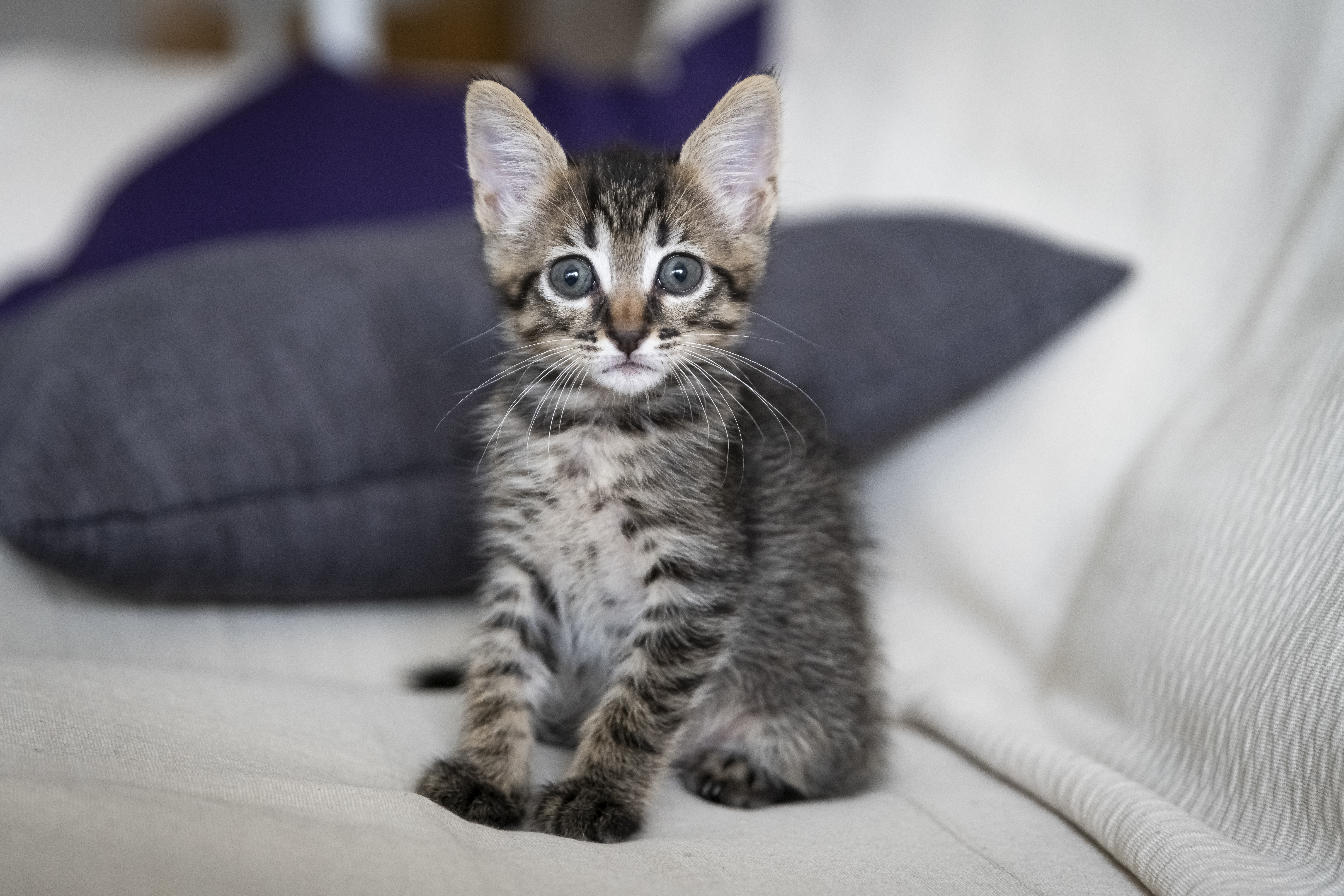
3) Early Development: The Sensitive Period of Socialisation
When a cat reacts defensively or avoids being touched, it is almost never out of "malice." To understand why, we can look at what science says about how animals develop and how their brains process emotions and feelings of safety.
Kittens have a critical sensitive period between 2 and 7 weeks of age. During this time, good experiences with people teach the kitten's nervous system that humans are safe. A kitten that has not been handled by people by 8 weeks of age usually does not form a bond with humans and often grows up feral or very distant.
4) The Emotional Brain: How Cats Feel and How Each Cat Sees the World
- The emotional systems of the brain: Research has shown that all mammals share deep brain systems that produce basic emotions. Systems like SEEKING (curiosity and the desire to engage) and CARE (nurturing and attachment) lead a cuddly cat to approach its guardian. When the FEAR or RAGE systems become too active, a reserved cat can get stuck in a defensive stance.
- Every cat has its own way of relating: A cat is not a blank slate. It is an active individual with its own way of thinking. A reserved cat has a distinct relational style: it approaches the world with caution, independence, and careful observation instead of physical closeness.
Overstimulation and the Nervous System
Many cats called "aloof" or "aggressive" are really suffering from overstimulation. A cat's nervous system is constantly checking whether it is safe or in danger. Cats have many touch receptors along the spine and at the base of the tail. When they are petted for too long, their nervous system can shift from a calm, safe state of connection to a state of alarm (ready to fight or flee) or even a state of shutting down. What looks to us like a sudden swipe is often a desperate attempt to say "stop, it's too much."
5) Nutritional Foundations: What the Mother Eats Shapes the Kitten
Behaviour is also built on a physical foundation, and nutrition is a big part of it. If the mother cat is poorly nourished during pregnancy or while nursing, her kittens can be more fearful, have learning difficulties, and be less sociable, and these problems can last into adulthood.
The Pottenger Study: Diet and Generational Impact
One of the most famous studies on this subject was carried out by Dr Francis M. Pottenger Jr. between 1932 and 1942. He followed more than 900 cats over several generations. All of them received a high-meat diet, but one group was fed raw food (including raw meat and raw milk), while the other groups received heat-processed food (cooked meat and pasteurised or evaporated milk).
Although the study was conducted decades ago and did not strictly follow modern experimental protocols—meaning its methods are viewed critically by contemporary standards—its findings remain a compelling landmark that offers valuable insight into how nutrition shapes biological resilience and behaviour.
Among these results, the cats fed raw food were healthier and more robust, had normal, large litters, and showed lower mortality rates. In contrast, the cats fed cooked and processed food developed extensive physical issues, including infertility, skeletal malformations, narrow dental arches, arthritis, organ dysfunction, and birth defects. Today, however, our focus is primarily on the behavioural outcome of these findings.
In terms of behaviour, the cats on raw food maintained a stable, balanced temperament. Those fed cooked and processed diets, on the other hand, displayed marked changes, including extreme nervousness, chronic anxiety, and persistent pacing. Males often became passive and unaggressive, whereas several females turned remarkably hostile and defensive.
Crucially, these behavioural changes were passed down across generations. They did not stop with a single animal; rather, they intensified with each successive generation, demonstrating that the maternal diet profoundly shaped not only the physical body of the descendants, but their neurological disposition as well.
6) The Cultural Lens: How Human Societies Shape Feline Behaviour
Biology does not act alone. The culture we live in also shapes how cats behave, in subtle but powerful ways. Studies comparing cats and people in different countries, such as the United States and Japan, show that the cultural environment influences how cats relate to us.
For example, research shows that pet cats and café cats in the United States spend more time close to people than cats in Japan do. Differences in home size, whether cats live indoors, attitudes toward pets, and everyday ways of interacting all create different small worlds for cats. A cat in a lively household full of interaction will express itself socially in a different way than a cat in a quieter home where personal space and independence are valued.
Conclusion: Building a Relationship, Not Demanding a Myth
In the end, understanding why one cat sleeps on your pillow while another sits quietly across the room means letting go of the idea that a cat "loves us more or less."
Cat affection does not follow one single pattern. It is a mix of many things: genes linked to the X chromosome, hormones, the critical weeks of socialisation, the way each cat's brain handles emotions, early nutritional foundations and generational development, the culture around the cat, and each individual cat's limits for what it can handle.
Respecting a cat does not mean forcing it into our human idea of affection (cuddling). Living well together means respecting each cat's individuality, learning to read its subtle signals, and building, day by day, a trusting relationship that fits who that cat really is.